The AI personal trainer market was valued at $16.8 billion in 2025 and is projected to reach $35 billion by 2030. That's not hype — it's a fundamental shift in how people access fitness guidance. But does an AI trainer actually deliver results comparable to a human trainer charging $80–150 per session? This article gives you an honest, side-by-side comparison with no spin. We'll cover where AI wins, where humans still have the edge, and who should use which.
What Is an AI Personal Trainer and How Does It Work?
An AI personal trainer is a software application that uses machine learning and natural language processing to create personalized workout programs, provide real-time coaching, and adapt your training plan based on your progress, feedback, and changing constraints. Unlike a static workout database or a generic 12-week PDF plan, an AI trainer dynamically adjusts — the way a human trainer would modify your program week to week, but available on your phone 24 hours a day.
Here's how it typically works:
- Onboarding conversation. You tell the AI your goals (lose fat, build strength, improve energy), your available equipment (bodyweight, dumbbells, gym), your schedule constraints (20 minutes, 3x/week), and any injuries or limitations.
- Plan generation. The AI builds a multi-week training program customized to your specific inputs — not a template, but a unique plan.
- Session guidance. During each workout, the app tells you exactly what to do: exercise, sets, reps, rest periods. Many include video demonstrations.
- Adaptive progression. As you complete workouts, the AI tracks your performance and automatically adjusts difficulty, volume, and exercise selection.
- 24/7 coaching. Most AI trainers include a chat interface where you can ask questions about exercises, nutrition, modifications, and programming at any time.
What Does a Human Personal Trainer Give You?
A good human personal trainer provides real value. Being honest about this is important — this isn't an article designed to trash human trainers. Here's what they genuinely offer:
- Hands-on form correction. A human can physically observe your movement patterns and provide immediate, tactile feedback. For complex lifts like deadlifts, squats, and Olympic movements, this is genuinely valuable.
- In-person accountability. For some people, having an appointment with a real person creates a level of social accountability that an app cannot replicate. Cancelling on a human feels different than closing an app.
- Injury assessment. Experienced trainers with appropriate certifications can identify movement compensations and make real-time exercise modifications based on visual observation.
- Motivation through presence. The energy of a good trainer — the encouragement, the coaching cues, the push to do one more rep — has a real psychological effect on performance.
- Relationship and trust. A long-term trainer-client relationship creates genuine rapport that some people find irreplaceable.
These are real advantages. The question isn't whether human trainers have value — they do. The question is whether that value justifies the cost for most people.
Where Do AI Trainers Beat Human Trainers?
AI personal trainers outperform human trainers in several critical areas — particularly the areas that matter most to busy women balancing work, family, and limited budgets. Here's the honest comparison:
| Feature | Human Trainer | AI Trainer |
|---|---|---|
| Cost per session | $80–$150 | $5–$20/mo (free trial) |
| Availability | By appointment only | 24/7 |
| Personalized plan creation | Yes | Yes |
| Remembers every detail of your history | Inconsistent | Always |
| Adapts plan when your schedule changes | If you notify them | Instantly |
| Available at 5am, 10pm, or midnight | No | Yes |
| Never cancels on you | No guarantee | Never |
| Zero judgment after missed weeks | Varies | Always |
| Works at home, hotel, or anywhere | Usually gym only | Anywhere |
| Answers questions any time of day | Business hours | Instantly, 24/7 |
| Hands-on form correction | Yes | No (video guides only) |
| In-person social motivation | Yes | No |
Where Do Human Trainers Still Win?
Human trainers still have meaningful advantages in two specific areas that AI cannot yet replicate. Being transparent about these limitations matters for giving you an honest recommendation:
- Hands-on form correction for complex movements. If you're learning Olympic lifts, advanced barbell movements, or rehabbing an injury with specific movement restrictions, a skilled human trainer watching your body in three dimensions can catch compensations that a phone screen cannot. For basic movements (squats, push-ups, lunges, planks), video demonstrations are sufficient — but for heavy or technical lifting, human eyes matter.
- In-person social accountability. Some people are wired to respond primarily to social commitment. If "I have an appointment with someone who's expecting me" is the only thing that gets you to work out, that's valid. AI trainers can check in and send reminders, but they can't replicate the feeling of someone physically waiting for you at the gym.
For the majority of exercisers — particularly beginners, intermediates, and people doing home workouts — these advantages don't outweigh the AI advantages in cost, availability, and adaptability. But for advanced lifters or people with specific clinical needs, a human trainer may still be the right choice, at least for periodic form checks.
Cost Breakdown: $80–150/Session vs. Under $5/Month
Cost is often the deciding factor, and the numbers are stark. Here's what each option actually costs over time, assuming a standard frequency of 3 sessions per week:
| Timeframe | Human Trainer ($100/session, 3x/wk) | AI Trainer (ALAN) |
|---|---|---|
| Per month | $1,200 | ~$13/mo or ~$5/mo annually |
| Per quarter | $3,600 | ~$15 (annual plan) |
| Per year | $14,400 | ~$60 (annual plan) |
| Over 3 years | $43,200 | ~$180 |
Even at a conservative $80/session (2x/week), you're spending $640/month — $7,680/year. That's a family vacation. A used car. A year of groceries. The financial barrier means most people can only afford 1–2 sessions per week, which limits the trainer's ability to build a comprehensive program. An AI trainer like ALAN costs less per year than a single month of human training — meaning you can train 4–5 days per week with full programming for a tiny fraction of the cost.
Who Should Use an AI Trainer vs. a Human Trainer?
The right choice depends on your specific situation. Here's a straightforward decision framework:
Choose an AI personal trainer if:
- Your budget is limited or you don't want to spend $640+/month
- You work out at home, during odd hours, or while traveling
- You're a beginner or intermediate exerciser
- You need flexible scheduling that adapts when life gets busy
- You want daily programming (4–5+ days/week)
- You prefer no-judgment accountability without social pressure
- You want to ask questions at midnight and get answers immediately
Choose a human personal trainer if:
- You're learning complex barbell or Olympic lifts and need hands-on form correction
- You have a specific clinical rehab need that requires in-person assessment
- Social appointment-based accountability is the only thing that works for you
- Budget is not a constraint
- You prefer in-person interaction as part of your fitness experience
Consider both (hybrid approach) if:
- You want periodic form checks from a human (monthly or quarterly) while using AI for daily programming
- You're transitioning from beginner to advanced and want a human to verify your technique on new movements
- You want the social experience of a trainer for 1 session/week and AI for the other 3–4
ALAN: What One AI Personal Trainer Actually Looks Like
To make this comparison concrete rather than abstract, here's what ALAN — an AI personal trainer with a free trial — actually does in practice. This isn't a sales pitch; it's a functional overview so you can see what AI training looks like day to day.
When you open ALAN for the first time, it asks you a series of questions in a conversational chat interface: your goals, available time, equipment, injuries, and experience level. Based on your answers, it generates a custom training plan within minutes — not a template selected from a library, but a plan built around your specific inputs.
Each training day, the app shows you exactly what to do: exercises, sets, reps, and rest periods. Every exercise includes video demonstrations so you can see proper form. As you complete sessions, ALAN tracks your performance and automatically adjusts difficulty — increasing weight suggestions, adding reps, or introducing new exercises as you get stronger.
The 24/7 chat is where ALAN differs most from a static app. You can ask it to modify today's workout ("My knee is bothering me — swap out the lunges"), ask nutrition questions, request a shorter session, or tell it you missed a few days and need a re-entry plan. It responds immediately, at any time of day.
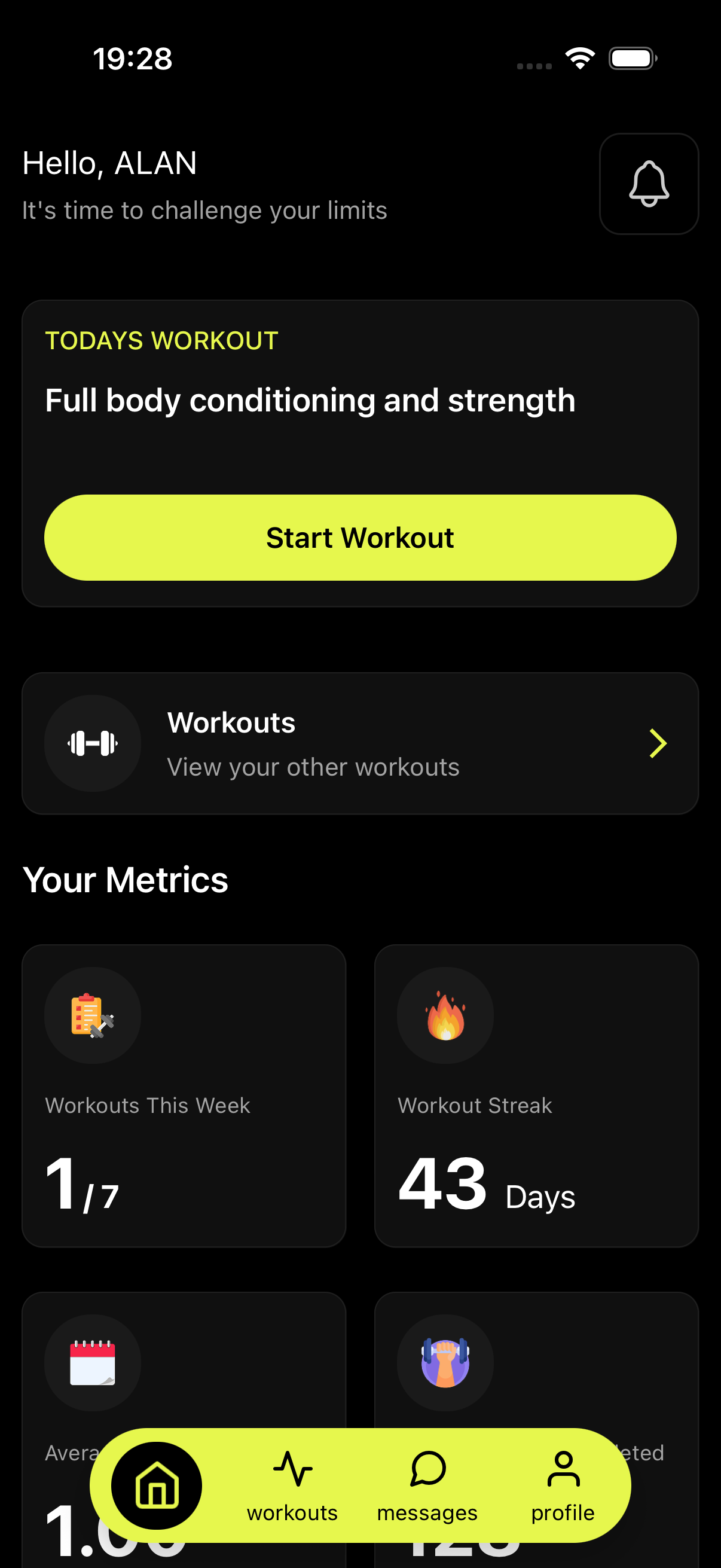
ALAN in action
Available on iOS and Android with a free trial. Here's what the actual app looks like.
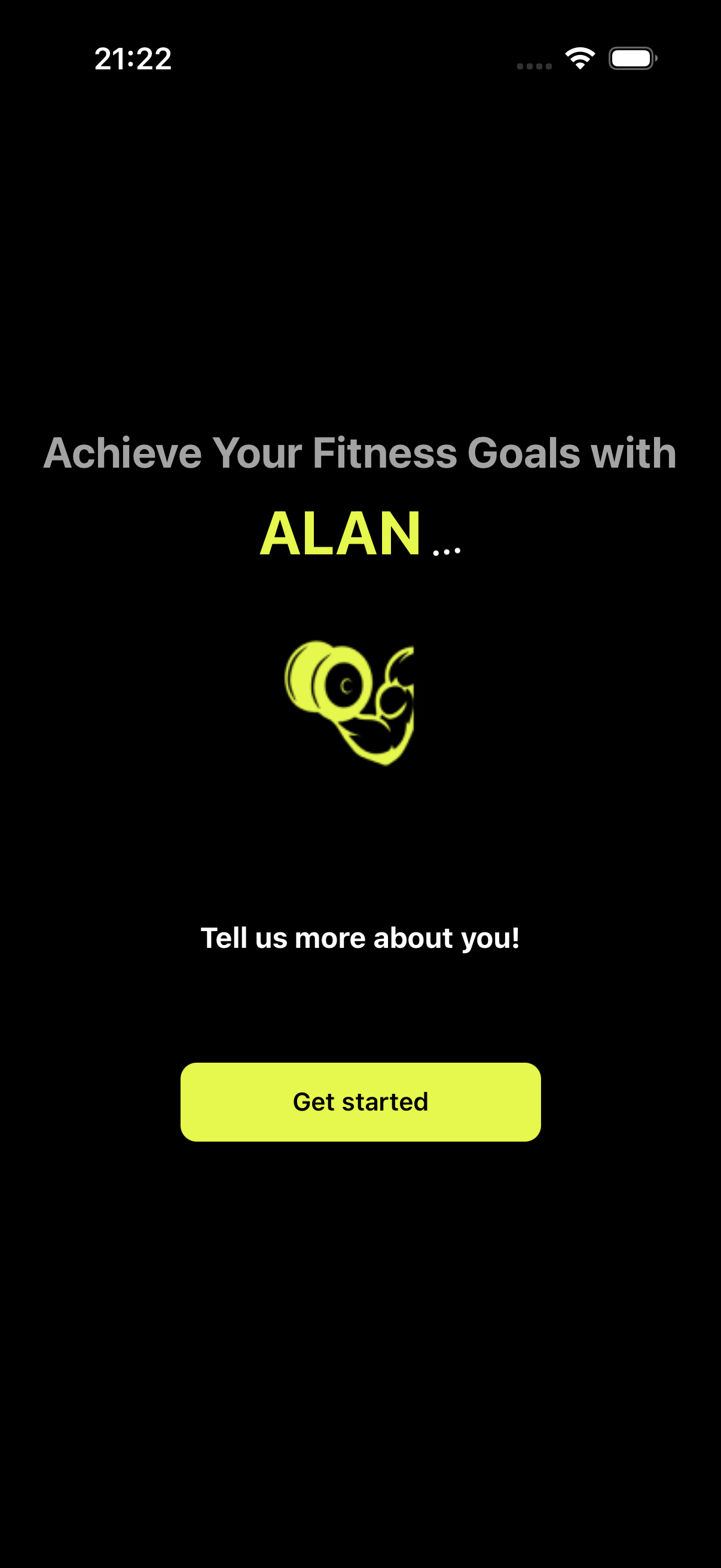
AI builds your plan
through conversation
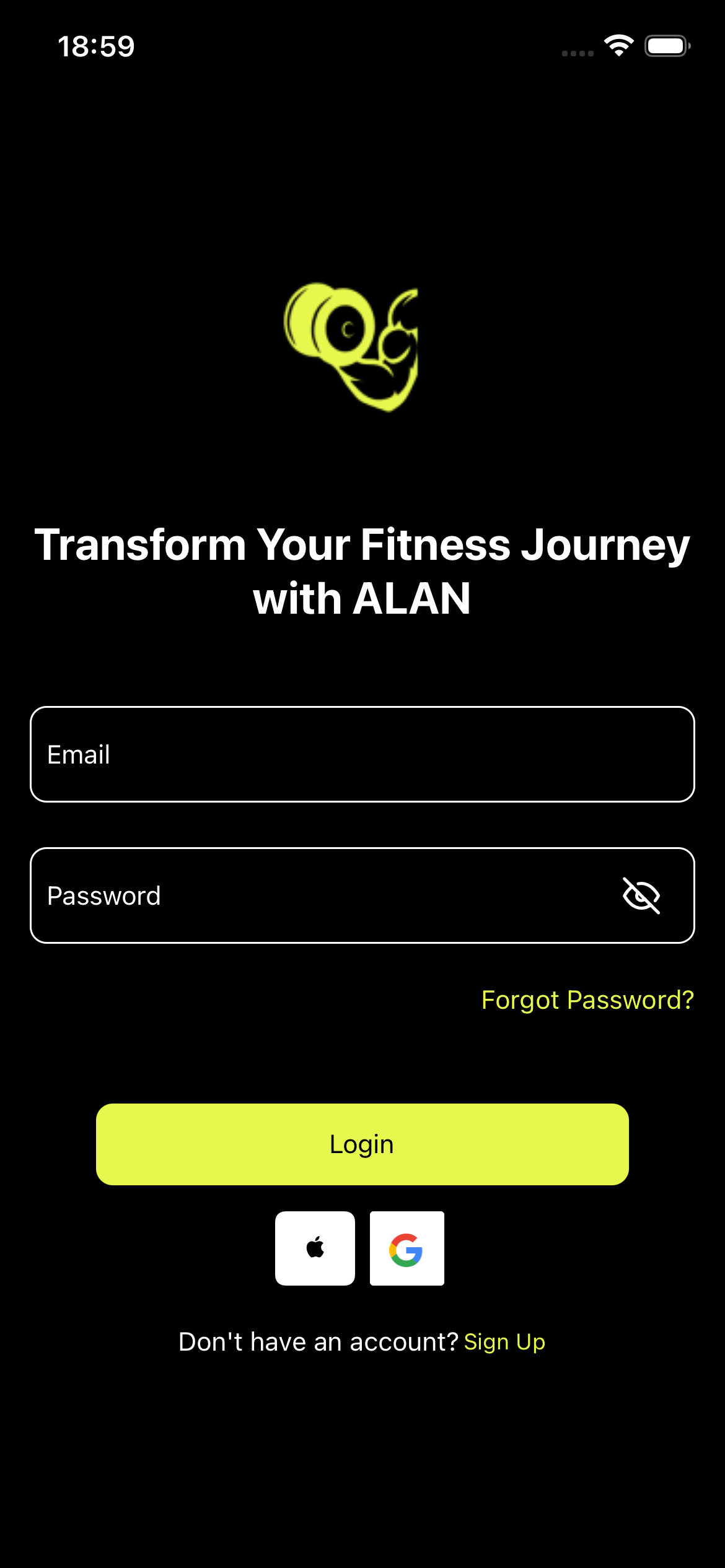
Custom workouts with
video-guided exercises
Ask anything, anytime.
Get answers instantly.
Try It Free — See for Yourself
ALAN builds your plan in 2 minutes and requires no equipment and no gym. Start with a free trial on iOS and Android.
Start Your Free Trial →Also available on Google Play
Frequently Asked Questions
What is an AI personal trainer?
An AI personal trainer is a software application that uses artificial intelligence to create personalized workout plans, provide real-time coaching, and adapt training programs based on your progress, schedule, and goals. Unlike static workout apps, AI trainers learn from your behavior and adjust dynamically — similar to how a human trainer would modify your program, but available 24/7 on your phone.
Can an AI replace a personal trainer?
For most people, yes — especially for those who need structured programming, accountability, and guidance but can't afford $80–150 per session. AI trainers excel at plan creation, consistency tracking, and 24/7 availability. Human trainers still have advantages in hands-on form correction for complex movements and in-person social motivation. The best approach depends on your budget, goals, and whether you need physical presence.
How much does a personal trainer cost in 2026?
In 2026, personal trainers in the US charge an average of $80–150 per session. At 2–3 sessions per week, this comes to $640–1,800 per month, or $7,680–21,600 per year. Online personal training is typically $200–500 per month. AI personal trainer apps typically cost $5–20 per month (often with free trials), making them 95–99% cheaper than human alternatives.
Are AI workout apps effective for weight loss?
Yes, when they provide personalized programming and progressive overload. The key factors for exercise-driven weight loss are consistency and appropriate exercise selection — both of which AI trainers optimize effectively. A 2024 systematic review in the Journal of Medical Internet Research found that app-based exercise interventions produced significant improvements in physical activity levels and body composition, particularly when they included personalized feedback and adaptive programming.
What is the best AI personal trainer app in 2026?
The best AI personal trainer depends on your specific needs, but key features to look for include: truly personalized plan generation (not templates), adaptive programming that adjusts to your progress, 24/7 AI coaching via chat, exercise video demonstrations, and progress tracking. ALAN is an AI trainer with a free trial that includes all of these features, available on both iOS and Android.
Do I still need a gym if I use an AI trainer?
No. Most AI personal trainers, including ALAN, can build effective workout plans using bodyweight exercises only or minimal home equipment like dumbbells and resistance bands. You can train entirely at home with sessions as short as 20–30 minutes. A gym membership is optional and depends on your equipment preferences and training goals.